
What the Click? Marketing Glossary / Cost Per Lead (CPL)
WHAT THE CLICK? · Know What’s Working
What Is Cost Per Lead? Know What Your Inquiries Cost
Cost per lead (CPL) is the amount you spend to generate each lead, using a defined set of costs and a clear definition of a lead. Calculate it by dividing the included cost by the number of leads in the same measurement period. The math is simple. Agreeing on what goes into it is where the useful conversation starts.
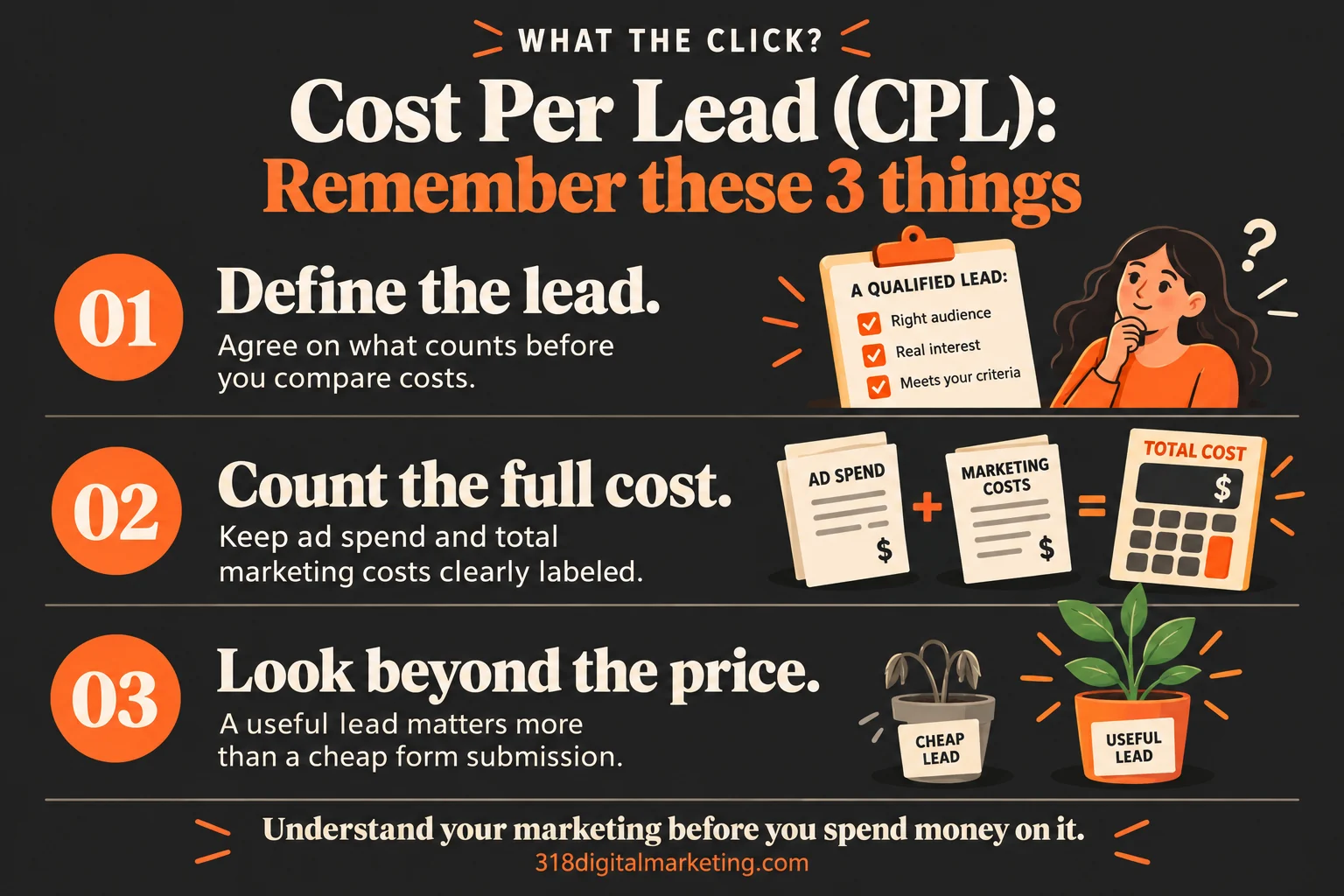
Remember these 3 things about Cost Per Lead (CPL)
Define the lead. Agree on what counts before you compare costs.
Count the full cost. Keep ad spend and total marketing costs clearly labeled.
Look beyond the price. A useful lead matters more than a cheap form submission.
By 318 Digital Marketing · Reviewed October 19, 2026
How do you calculate cost per lead?
Use this formula: included marketing cost ÷ leads generated = cost per lead. If a campaign spends $1,000 and produces 20 counted inquiries, its ad-spend CPL is $50. If you include another $500 in campaign fees, the combined CPL is $75. Both can be useful; they answer different questions. Label them so nobody accidentally compares apples with a fruit basket.
What counts as a lead?
Decide whether your denominator includes all form submissions, genuine inquiries, or qualified opportunities. Spam, duplicate submissions, existing customer requests, and people outside your service area can distort the picture. Your lead quality criteria help separate the total from the prospects your business can actually serve.
Is CPL the same as cost per conversion?
Only when the conversion being counted matches your lead definition. Google Ads defines average CPA around the cost of counted conversions. A conversion might instead be a purchase or another action. Ask which event the report uses before treating its cost-per-conversion figure as your cost per real inquiry.
A North Louisiana example
Imagine a Minden contractor spending $1,500 in combined campaign costs. Twenty inquiries gives a $75 CPL, but only five meet the agreed fit criteria. Cost per qualified lead is then $300. If two become customers, the same spend represents $750 per acquired customer. These are illustrative numbers, not market benchmarks. Profitability depends on the work sold, delivery costs, and other acquisition expenses.
What can improve the number?
Clear targeting, a relevant offer, a usable page, and reliable follow-up can all help. Start with conversion tracking that counts the right action. Then investigate where the process loses good prospects. A campaign that produces fewer, better inquiries may be healthier even if the headline CPL rises.
Ask before you approve the budget
Which costs are included? What counts as a lead? How are duplicates and spam handled? Are we comparing the same channel, time period, and qualification rules? How long does a lead normally take to become a customer? Set the definitions before a report makes a cheap number look like a victory.
FREQUENTLY ASKED QUESTIONS
Still wondering?
Quick answers before you go. Open any question below.
What is a good cost per lead?
There is no universal number. Work backward from customer value, delivery costs, close rate, and the acquisition costs your business can support.
Should I include agency fees?
Include them when evaluating combined marketing efficiency, and label that calculation separately from ad-spend-only CPL.
Can a cheaper lead be worse?
Yes. Cheap inquiries may be spam or poor fits. Compare qualified opportunities and customers before choosing a campaign by CPL alone.
Is a lead the same as a customer?
No. A lead is an inquiry or prospect under your definition. Cost per customer uses the number who actually became customers.
What if my campaign generates zero leads?
You cannot calculate a meaningful finite CPL by dividing by zero. Report the spend and zero leads clearly, then investigate demand, targeting, the offer, and measurement.
Put the idea to work
Want help applying this to your business? Got big ideas? Let’s talk.
Examples are illustrative. Features, requirements, and results vary; use the linked documentation to check the details that apply to your situation.