
What the Click? Marketing Glossary / Keywords & Search Terms
WHAT THE CLICK? · Make Sense of Advertising
Keywords vs. Search Terms: What Are Customers Really Typing?
In keyword-based search advertising, a keyword is a targeting input you choose, while a search term is the actual query a person enters. Matching rules connect the two, so the words do not always match exactly. In SEO conversations, “keyword” is also used more broadly for a topic or query you want a page to address. Context matters.
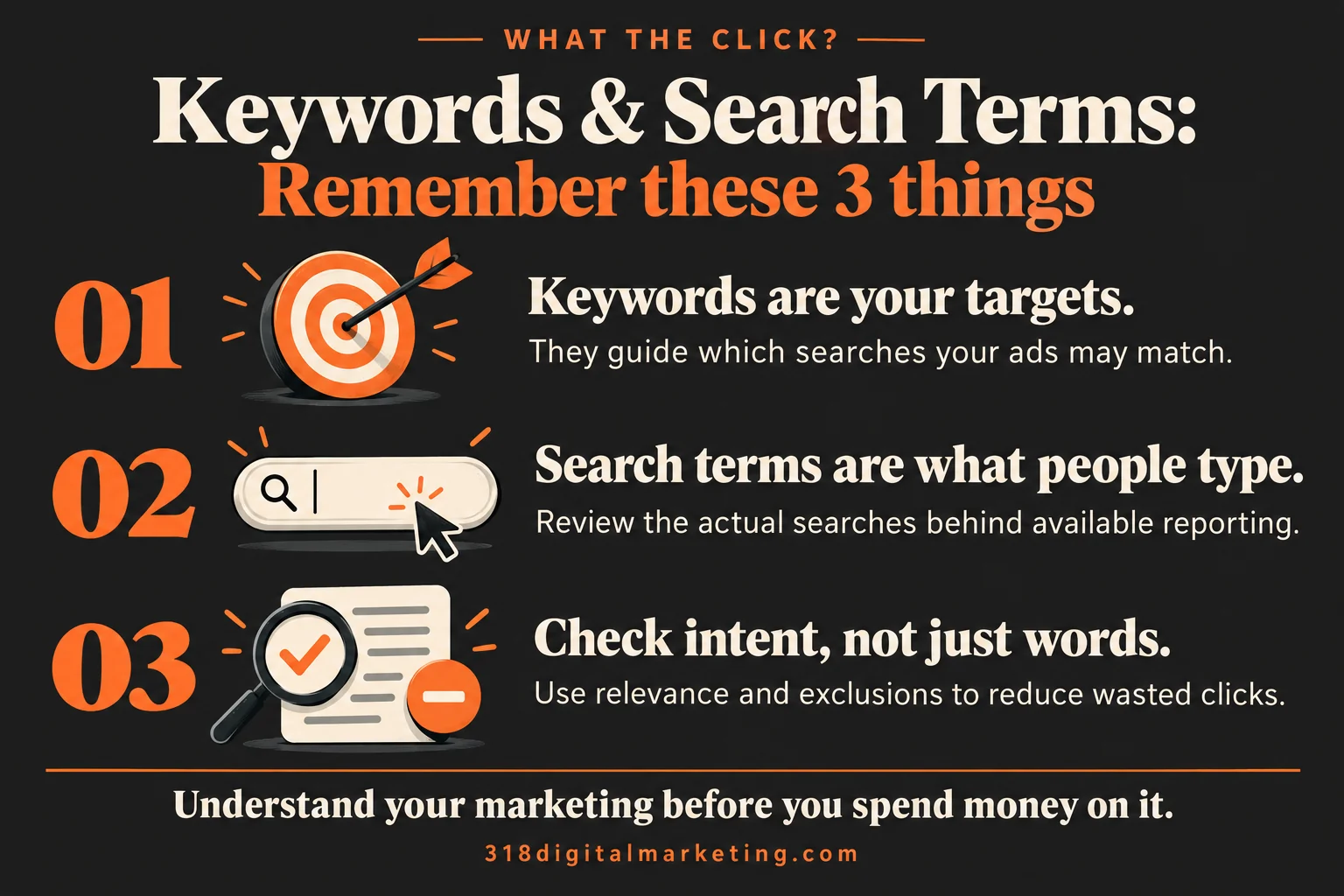
Remember these 3 things about Keywords & Search Terms
Keywords are your targets. They guide which searches your ads may match.
Search terms are what people type. Review the actual searches behind available reporting.
Check intent, not just words. Use relevance and exclusions to reduce wasted clicks.
By 318 Digital Marketing · Reviewed October 19, 2026
How do keywords connect to searches?
Match settings and platform systems influence which searches are eligible to trigger an ad. Google’s keyword matching guidance explains broad, phrase, and exact matching. Matching can involve meaning and intent, not only a literal sequence of letters. Even an exact-match label should not be read as a promise that every query will be character-for-character identical.
Why review the actual searches?
A campaign’s keyword list shows what was selected for targeting. Search-term reporting helps reveal the queries behind available activity. Google’s search terms report can support relevance checks, with reporting limits that mean it is not necessarily a complete record of every query. Ask to see the available search terms, not just a polished list of intended targets.
A Minden example
Imagine a roofing company targeting roof repair. A homeowner asking for a local repair estimate has different intent from someone searching for roof-repair jobs or training. Some queries may use similar words while serving very different needs. The business should assess the meaning before paying to send everyone to the same page.
How do negative keywords help?
Negative keywords can exclude unwanted matches under the platform’s rules. Use them thoughtfully: an overbroad exclusion may block relevant demand too. Review the service, location, and intent behind a query before adding it. The point is to reduce wasted PPC traffic, not to create the longest possible exclusion list and call it optimization.
What about SEO keywords?
For SEO, focus on understanding customer questions and creating useful pages that address them. A page can serve related searches without repeating one phrase in every sentence. The language customers use is valuable research; it is not an invitation to turn your homepage into a word cloud wearing a necktie.
Ask before approving the keyword strategy
Which services and locations are being prioritized? What intent does each group represent? Which match settings are used? How often are search terms reviewed, and who approves exclusions? How will inquiry quality inform changes? A relevant keyword starts the conversation; the actual query and resulting customer experience tell you whether the campaign followed through.
FREQUENTLY ASKED QUESTIONS
Still wondering?
Quick answers before you go. Open any question below.
Are keywords and search terms interchangeable?
Not in a keyword-targeted ad account. A keyword is a chosen targeting input; a search term is what the person searched.
Does exact match mean identical wording?
Not necessarily. Platforms can include close variants or searches with the same meaning under current matching rules. Check the documentation for the platform.
Will the search terms report show everything?
Not always. Privacy thresholds and reporting rules can limit which queries appear. Use the available report without calling it a complete customer-search ledger.
Should every search term become its own page?
No. Group genuinely related needs and create distinct pages when they offer distinct value. Tiny wording differences do not automatically justify another page.
Can negative keywords hurt results?
Yes, if they exclude relevant searches. Review intent and matching behavior before applying them broadly, then monitor the effect.
Put the idea to work
Want help making sense of your marketing? Got big ideas? Let’s talk.
Examples are illustrative, not benchmarks. Definitions and available reports vary by platform; check the linked documentation for the details that apply to your account.