
What the Click? Marketing Glossary / Pay-Per-Click Advertising (PPC)
WHAT THE CLICK? · Make Sense of Advertising
What Is PPC? A Guide Before You Pay for Clicks
Pay-per-click advertising is an advertising model in which you pay when someone clicks an ad. Search ads are a common example. A click buys a visit or interaction; it does not guarantee an inquiry, sale, or qualified customer.
By 318 Digital Marketing · Reviewed October 19, 2026
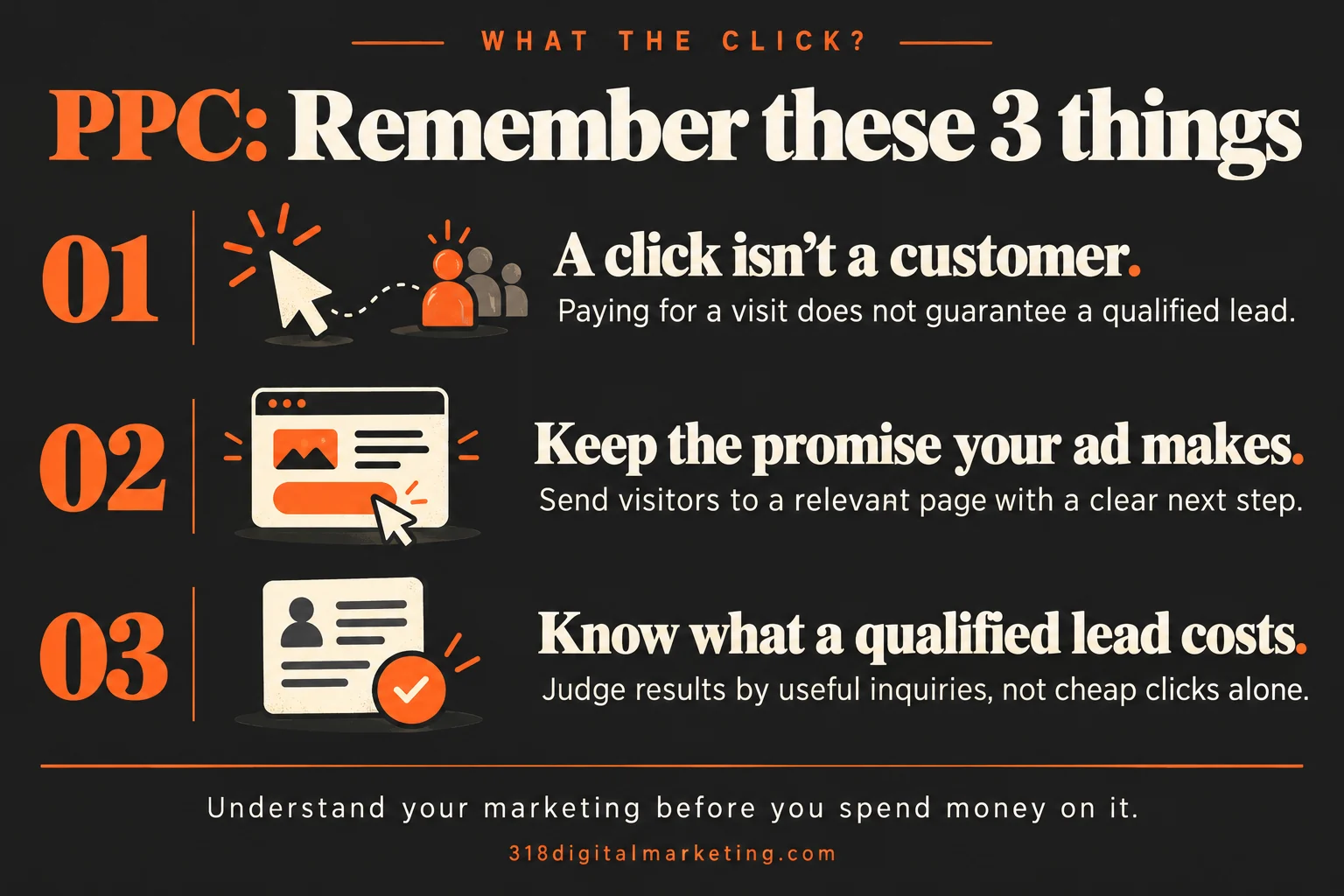
Remember these 3 things about Pay-Per-Click Advertising (PPC)
A click isn’t a customer. Paying for a visit does not guarantee a qualified lead.
Keep the promise your ad makes. Send visitors to a relevant page with a clear next step.
Know what a qualified lead costs. Judge results by useful inquiries, not cheap clicks alone.
How PPC works
An advertiser chooses an audience or searches to target, creates ads, and sets a budget and bidding approach. The platform decides when ads are eligible to appear. Not every advertising campaign uses click-based billing, even when people casually call all paid advertising “PPC.” Ask how your specific campaign is charged.
From click to customer
An ad promises something. The landing page needs to deliver that promise, explain the offer, and make the next step clear. A Shreveport service business advertising estimates should send people to information about that service, rather than a generic page that leaves visitors hunting for a phone number.
The numbers that matter
Cost per click tells you what traffic costs. Conversion rate tells you how often visits produce a defined action. Cost per lead connects spending to inquiries. Lead quality and close rate tell you whether those inquiries are useful. Cheap clicks can be expensive if none turn into customers.
A simple budget example
Suppose an illustrative campaign spends $600 and generates 120 clicks. That is $5 per click. If six people submit an inquiry, the ad spend per inquiry is $100. If only two inquiries fit your service, the spend per qualified inquiry is $300. This example excludes management fees and is not a performance forecast.
Watch your wallet
Separate platform spend, management fees, landing-page costs, and tracking costs. Confirm that your business controls the ad account. Ask how searches, locations, schedules, and exclusions will be reviewed. More budget can amplify a poor landing page just as easily as a good one.
Ask before you buy
What counts as a qualified lead? Where will ads send visitors? How will calls and forms be verified? Who reviews irrelevant traffic? What test would make you change direction? Agree on a useful reporting rhythm and avoid treating every tracked action as a sale.
FREQUENTLY ASKED QUESTIONS
Still wondering?
Quick answers before you go. Open any question below.
Is PPC the same as Google Ads?
Google Ads is a platform that offers several campaign types. PPC is a billing model used across platforms; the terms are not interchangeable.
How much should I spend?
Start with your market, offer, expected acquisition economics, and a budget you can afford to test. There is no universal amount that guarantees results.
Does the highest bidder always win?
No. On Google Search, auction outcomes also involve ad quality, context, thresholds, and the expected impact of ad assets.
Will PPC improve my organic rankings?
Paying for ads does not buy a higher organic search position. Paid and organic activity can support a broader strategy, but they remain separate placements.
Should I use my homepage as the landing page?
Only if it clearly matches the ad’s promise and next step. A focused service or campaign page is often easier to align and measure.
Keep connecting the dots
SEO · Local SEO · Website Ownership · Conversion Rate
Further reading: Google Ads: how the ad auction works. Examples are illustrative; costs and results vary.
Want help applying this to your business?
Explore our paid advertising services, or tell us what you’re working on.
Use conversion rate to understand what visitors do after the click. Compare paid advertising with SEO when planning your budget.