
What the Click? Marketing Glossary / Impressions
WHAT THE CLICK? · Know What’s Working
What Are Impressions? Understand What Was Actually Shown
An impression is a counted appearance of an ad or piece of content under a platform’s reporting rules. Impressions tell you how often something was shown, not how many different people saw it or whether they paid attention. One person can generate several impressions. A big number is a starting point, not a customer count.
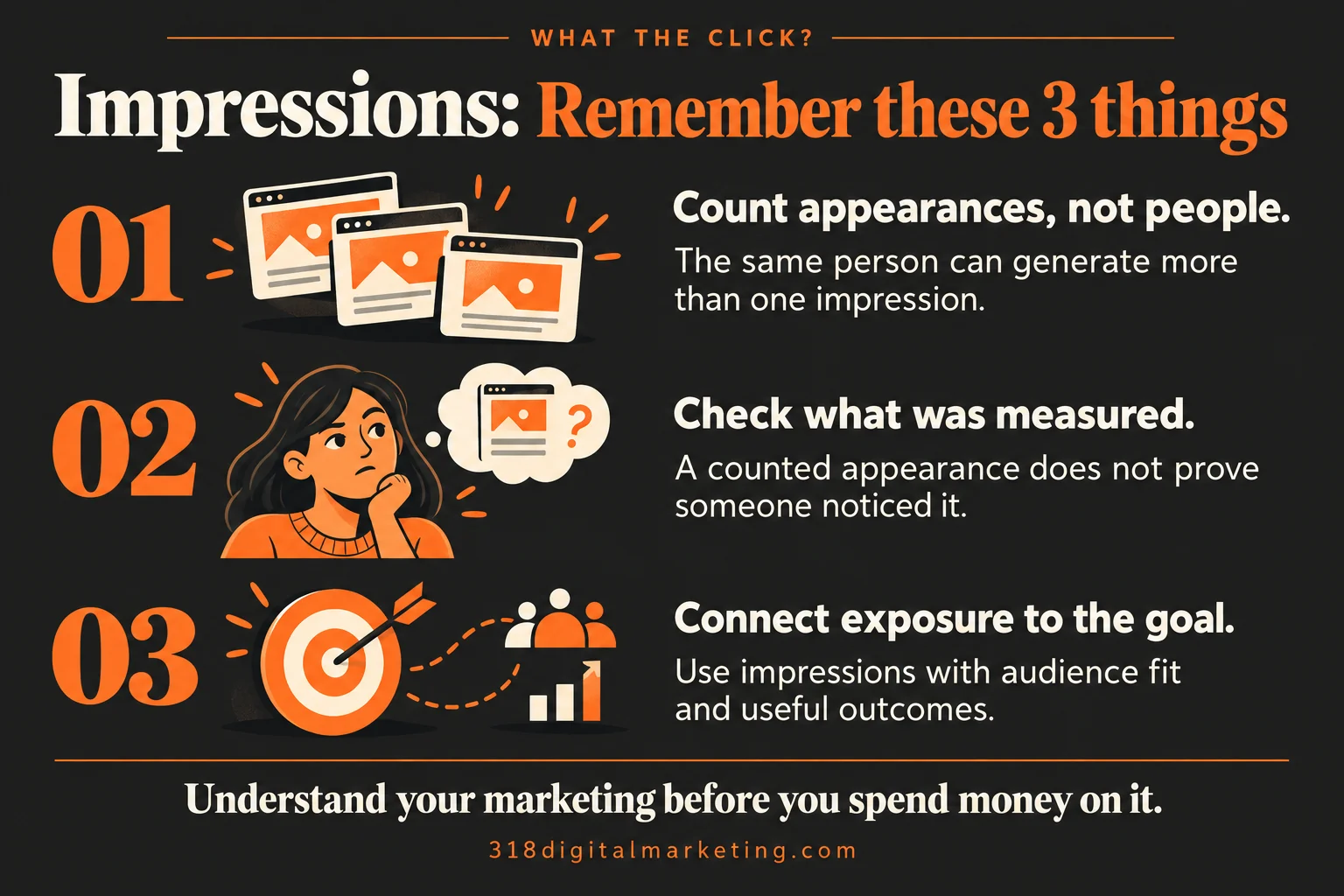
Remember these 3 things about Impressions
Count appearances, not people. The same person can generate more than one impression.
Check what was measured. A counted appearance does not prove someone noticed it.
Connect exposure to the goal. Use impressions with audience fit and useful outcomes.
By 318 Digital Marketing · Reviewed October 19, 2026
How do impressions work?
Different platforms define appearances for their own formats. Google Ads counts an impression when an ad is shown on its relevant surfaces. Other products and reports have their own rules. Check the definition behind the column, particularly when comparing search listings, social content, display ads, and video.
Impressions versus people
If one person is shown an ad three times, that can produce three impressions. Reach addresses the unique audience instead. Repetition may help reinforce a message, but more appearances are not automatically more potential customers. A report should make the distinction clear without requiring you to bring a magnifying glass to the footnotes.
A North Louisiana example
Imagine a Minden business promoting a new service. A report lists 3,000 impressions. That does not establish that 3,000 local residents noticed the offer, remembered the name, or needed the service. Ask where the appearances happened, which audience was targeted, and whether the offer generated useful interest. The example is illustrative, not a campaign benchmark.
Shown does not always mean noticed
An impression is a technical reporting event, not proof of human attention. Some platforms offer a separate viewability metric with specific requirements. Do not treat served impressions, viewable impressions, video views, and completed views as interchangeable. Even a viewable placement cannot tell you that someone read every word while waiting for their coffee.
What should you look at next?
Use impressions in context with audience fit, spend, and the campaign’s job. If the goal is traffic, click-through rate helps show how often appearances lead to clicks. If the goal is inquiries, inspect what happens afterward. Awareness activity can have value, but the report should explain why its chosen measures match the objective.
Ask before you celebrate
What counted as an impression? Was the audience relevant to our service area? How much repetition was involved? Were we paying for exposure or clicks? Which outcomes can we observe? Impressions are useful when they answer a defined question. On their own, they do not prove that the phone rang.
FREQUENTLY ASKED QUESTIONS
Still wondering?
Quick answers before you go. Open any question below.
Are impressions the same as views?
Not necessarily. Platforms use different rules for impressions and video or content views. Read the definition for the exact report.
Can one person create multiple impressions?
Yes. Repeated appearances to the same person can increase impressions without increasing the unique audience.
Are more impressions always better?
No. The relevance of the audience, cost, frequency, and campaign purpose matter. Exposure outside the people you can help may add little value.
Does an impression mean someone clicked?
No. An appearance and a click are different events. A person can be shown content without interacting with it.
Why did my impressions fall?
Possible reasons include changes in budget, targeting, demand, eligibility, competition, or reporting. Investigate the affected channel before assuming the whole strategy failed.
Put the idea to work
Want help making sense of your marketing? Got big ideas? Let’s talk.
Examples are illustrative, not benchmarks. Definitions and available reports vary by platform; check the linked documentation for the details that apply to your account.