
What the Click? Marketing Glossary / Marketing Attribution
WHAT THE CLICK? · Know What’s Working
What Is Marketing Attribution? Follow the Customer Journey
Marketing attribution is the process of assigning credit for a measured outcome to marketing interactions along a customer’s journey. A model might credit the last eligible interaction or distribute credit across several interactions. Attribution helps organize the evidence you have; it does not reveal every reason a person chose your business.
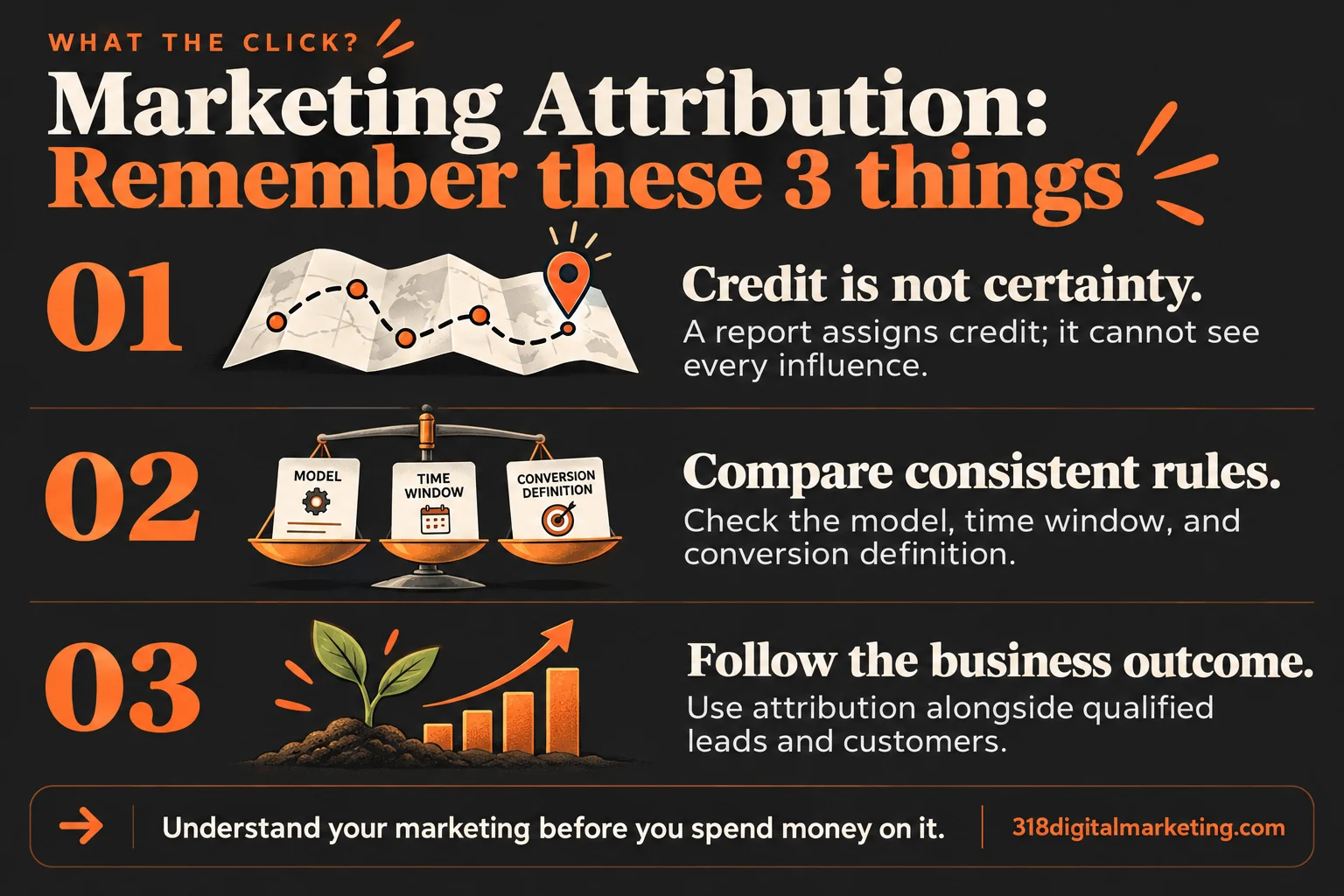
Remember these 3 things about Marketing Attribution
Credit is not certainty. A report assigns credit; it cannot see every influence.
Compare consistent rules. Check the model, time window, and conversion definition.
Follow the business outcome. Use attribution alongside qualified leads and customers.
By 318 Digital Marketing · Reviewed October 19, 2026
How does attribution work?
A reporting system connects available interactions with a defined outcome using its rules, identifiers, and measurement window. Google Analytics’ attribution guide describes how credit is assigned along a path to an important action. What the system can observe depends on implementation, consent, devices, and platform limits.
Why the model matters
Different models can tell different stories about the same journey. A last-interaction view emphasizes the final measured touch. A model that distributes credit may show earlier contributions. Neither should be read as a complete causal explanation. Attribution answers “where did this system assign credit?” Proving whether a campaign caused additional business requires a different kind of evidence, such as a well-designed experiment.
A Shreveport example
Imagine someone hears about a local business from a friend, reads an article, later sees an ad, and returns by searching the company name. A report might credit the final search while missing the conversation with the friend. That does not mean the article or ad did nothing. It means the customer journey was more interesting than the last line in the dashboard.
Why platforms disagree
Platforms can use different conversion definitions, time windows, identity methods, and rules about impressions or clicks. Two systems may each claim the same inquiry. Start with reliable conversion tracking, then document those differences. Do not add every platform’s claimed conversions together and present the result as a count of unique customers.
Use attribution to ask better questions
Compare consistent periods and definitions, inspect patterns, and check whether the credited inquiries are useful. When reviewing cost per lead, make sure the cost and credited lead count cover compatible activity. Match reporting with business records and ask customers how they found you when appropriate. Self-reported answers add context, but memory is imperfect too.
Ask before a reporting overhaul
Which outcome are we attributing? What model and window apply? Which interactions can the tools observe? Are we reporting leads or customers? How are duplicate claims handled? A useful report acknowledges uncertainty while still supporting decisions. It should not dress a guess in a pie chart and call the mystery solved.
FREQUENTLY ASKED QUESTIONS
Still wondering?
Quick answers before you go. Open any question below.
Does attribution prove which campaign caused the sale?
No. It assigns credit under a set of rules. Incremental impact requires additional evidence about what would have happened without the marketing.
Why does direct traffic get credit?
Direct can include visits without usable source information. It is not a reliable label for everyone who typed your address intentionally.
Should I use one attribution model forever?
Use consistent rules for comparisons, review whether they fit your decisions, and document changes so shifts in reporting are not mistaken for shifts in performance.
Can offline referrals be included?
Business records and appropriate integrations can add context. They still need consistent definitions and should not be treated as perfectly complete observations.
What should a small business do first?
Define the important outcome, verify tracking, label campaigns consistently, and compare the report with actual inquiries and customer records before adding complexity.
Put the idea to work
Want help applying this to your business? Got big ideas? Let’s talk.
Examples are illustrative. Features, requirements, and results vary; use the linked documentation to check the details that apply to your situation.